
About the Tulsa County Clerk
Michael Willis is the Tulsa County Clerk. He was elected to the office on June 28, 2016. The County Clerk maintains records for county government rather than the courts. That work covers land and real-estate recording, county commission materials, agendas, and budgets. The office sits on the seventh floor of the county headquarters in downtown Tulsa.
The County Clerk also runs the county's open-records process for non-court documents. Real Estate Services handles land records, recording, and online subscriptions. The office posts a fee schedule, an e-filing tool, documentary stamp tax details, and a RecordRadar alert service. Staff record deeds and mortgages but do not give legal or title advice.
The screen below is the official County Clerk homepage.
The starting point for most services is the Tulsa County Clerk homepage.
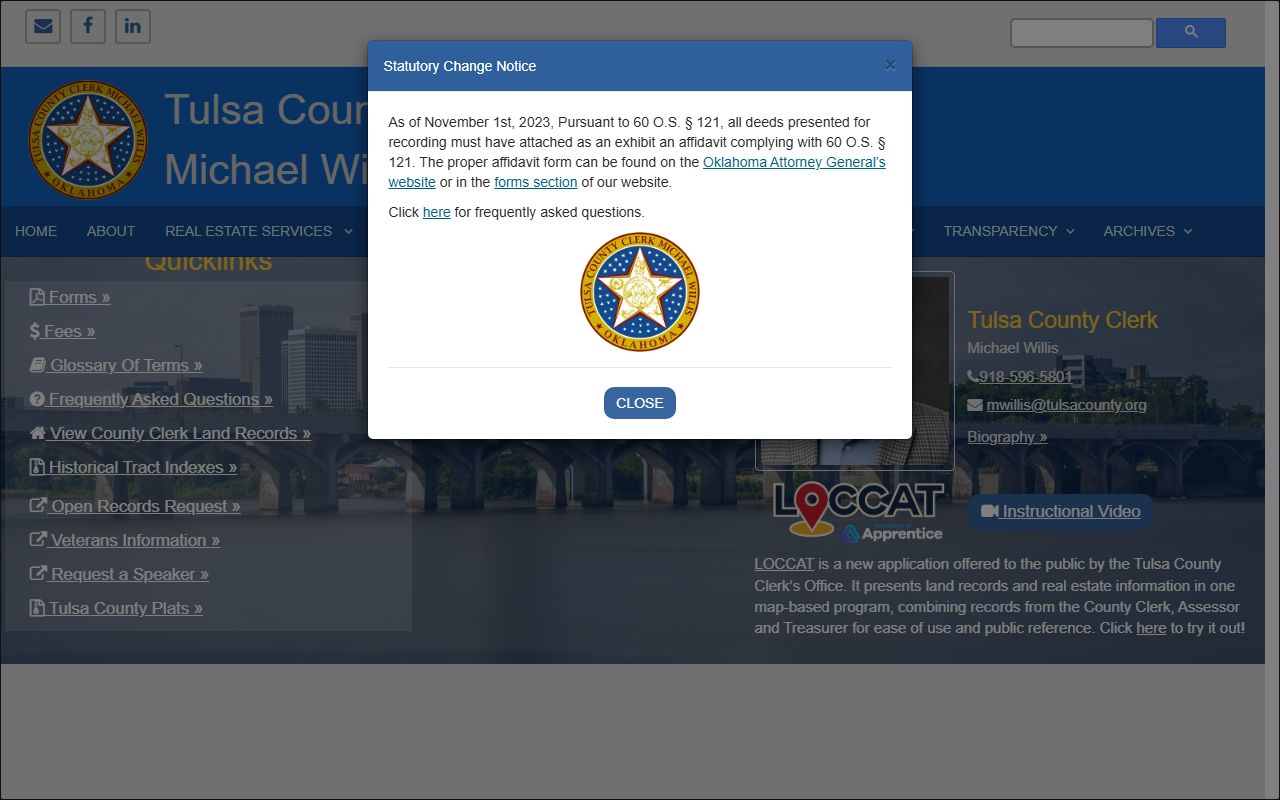
The homepage links the fee schedule, e-filing, documentary stamp tax, land records, and the open-records request. Each of those tools is described in more detail below.
Tulsa County Clerk
Clerk: Michael Willis
218 W. 6th St., 7th Floor
Tulsa, OK 74119-1004
918-596-5801
mwillis@tulsacounty.org
Mon-Fri 8:00 AM - 5:00 PM
What the Tulsa County Clerk Records
The County Clerk is the recorder for county government and property documents. The office logs and indexes records so the public can find them later. It is not where court cases are filed. The main functions break down into a short list.
- Land and real-estate records, including deeds, mortgages, liens, and releases.
- Documentary stamp tax on qualifying property transfers.
- County commission materials, meeting agendas, and minutes.
- County budgets and financial filings.
- Open-records requests for county government documents.
- E-filing and online land-record subscriptions through Real Estate Services.
The RecordRadar service lets property owners get alerts when a document is recorded against their name. That feature helps guard against fraudulent filings. The office cannot, however, search or release District Court case files.
The County Clerk also serves as the records hub for the Board of County Commissioners. Agendas, meeting minutes, resolutions, and budget documents pass through the office and become part of the public record. Vendors and the public can review county purchasing and financial filings the same way. This makes the County Clerk a central point for transparency in county government, separate from anything that happens in a courtroom.
County Clerk vs Court Clerk
Tulsa County keeps two separate clerk offices. The names are close, so requests often land in the wrong place. The dividing line is simple. If a record came from a court case, it belongs to the Court Clerk.
The County Clerk holds property and county government records. Deeds, mortgages, liens, county budgets, commission agendas, and open-records for county departments all start here. The Court Clerk holds court case files instead. Criminal and traffic cases, civil suits, divorce decrees, probate filings, protective orders, marriage licenses, and search warrants are all maintained by the Court Clerk. Court case files, certified copies of decrees, and marriage licenses come from the Tulsa County Court Clerk, never the County Clerk.
Note: A deed, mortgage, or county budget points to the County Clerk, while a lawsuit, charge, divorce, or probate matter points to the Court Clerk.
Tulsa County Land Records and Subscriptions
Real Estate Services is the County Clerk unit for land records. The public can search recorded documents online through a web subscription. Plans run from a single day up to a full year. The table lists the posted subscription rates.
| Subscription | Fee |
|---|---|
| One day | $5.00 |
| One month | $30.00 |
| Six months | $120.00 |
| One year | $360.00 |
The land-records page shows how Real Estate Services works.
Details and access begin on the Tulsa County Clerk Real Estate Services page.
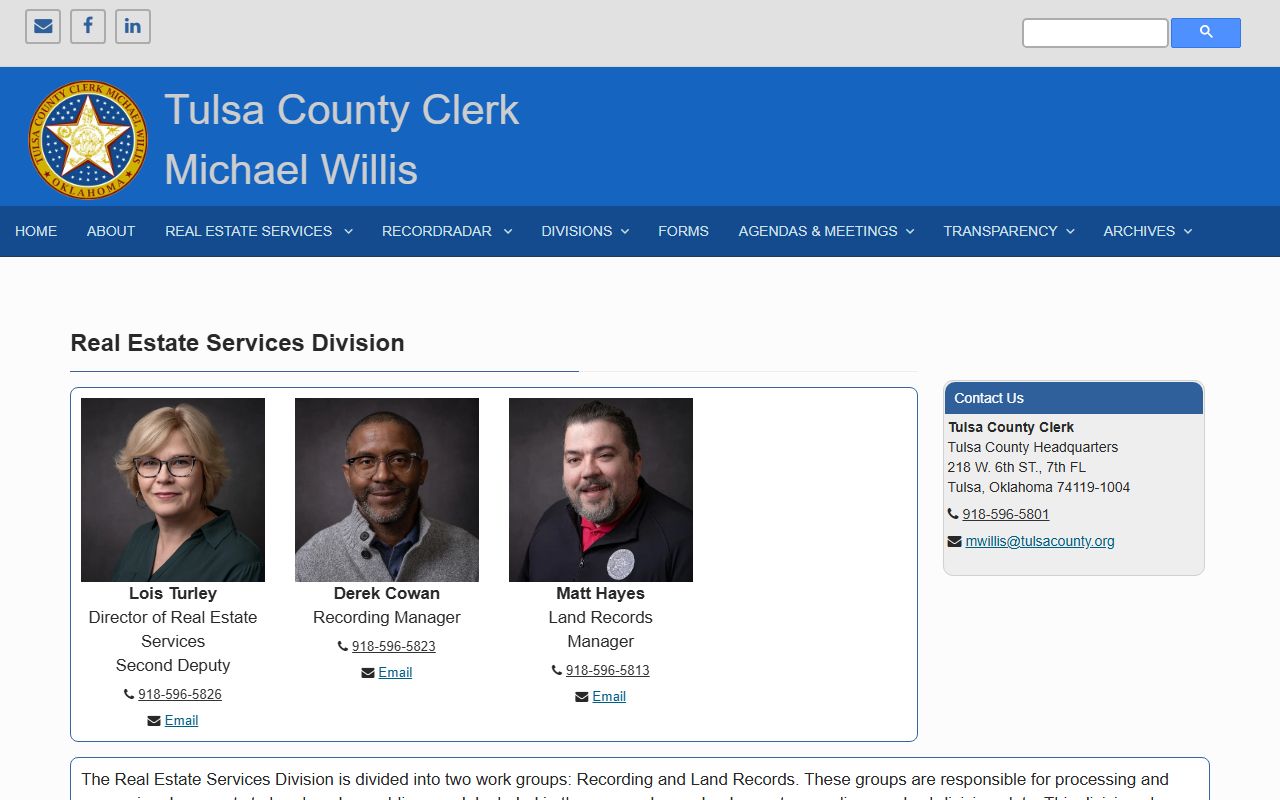
A short subscription suits a one-time deed lookup, while a longer plan fits title and real-estate professionals. The fee schedule and e-filing tools are linked from the same page.
Land records index more than just sales. The same system holds mortgages, releases of lien, easements, plats, and other recorded instruments tied to property in the county. A searcher can trace ownership history and check whether a lien is still on file. The RecordRadar alert tool watches for new filings made against a name and sends a notice when one appears. That feature gives property owners an early warning against fraudulent recordings. Title companies, lenders, and researchers use the subscription daily, while a single-day plan covers a one-time check.
How to File a County Open Records Request
County government documents that are not online can be requested in writing. The Open Records Act lets the public inspect or copy non-exempt county records. The county uses a standard request form routed to the County Clerk. The steps below outline the process.
- Download the county open-records request form from the county website.
- Fill in your name, the date, your mailing address, and a telephone number.
- State whether the request is for business or personal use, and check whether you want to inspect or copy.
- Describe the records clearly, naming the department, document type, and date range when known.
- Send the signed form to County Clerk Michael Willis at mwillis@tulsacounty.org and wait for the office to respond with records or a cost estimate.
A precise description speeds the response. This route is for county government records only. Court case files go through the Court Clerk, and sheriff records follow the separate TCSO request channel.
The request runs under the Oklahoma Open Records Act, which the office applies to county documents. Once the form arrives, staff locate the records and send either the documents or a cost estimate for copies. Oklahoma law lets a public body recover copying costs and certain direct search costs, so a large request can carry a fee before the copies are released. There is no rigid deadline in the statute, but the office is expected to respond within a reasonable time. Keeping the description narrow lowers both the wait and the copy charge. Note: A broad or vague request usually returns a higher cost estimate, so naming the exact department and date range keeps the fee down.
County Open Records Form Fields
The county open-records form asks for a short set of details. Each field helps staff route and answer the request. The form is addressed to the County Clerk for county government records. The table shows what to provide.
| Field | Required | Notes |
|---|---|---|
| Requestor name | Yes | Printed name of the person asking. |
| Date | Yes | The day the request is filed. |
| Mailing address | Yes | Where the response or copies should go. |
| Telephone number | Yes | A contact number for follow-up. |
| Business or personal use | Yes | State how the records will be used. |
| Inspect or copy | Yes | Choose to view records or receive copies. |
| Description of records | Yes | Department, document type, and date range. |
The form is online as a county PDF and routes to Michael Willis. You can open the Tulsa County open records request form directly. Copy fees may apply depending on the size of the request.
Documentary Stamp Tax and Recording
The County Clerk collects documentary stamp tax when qualifying property changes hands. The tax is tied to the value of the transfer and is paid when the deed is recorded. Recording places the document in the public land record. That public entry protects ownership and lien priority.
The office also supports e-filing for many recordable documents, which speeds the process for title companies and lenders. A full fee schedule for recording and copies is posted on the County Clerk website. The stamp tax is a common surprise for first-time sellers, so checking the rate before closing avoids a delay at recording.
Probate matters that move real property show up in two places. The estate file stays with the Court Clerk, while any resulting deed is recorded with the County Clerk. A personal representative who sells estate land records the new deed here even though the case was decided in the courtroom. The estate case itself is covered on the Tulsa County probate records page.
Tulsa County Clerk Leadership
Michael Willis leads the office as the elected County Clerk. The bio page lists his background, contact block, and the office address on West 6th Street. It also confirms the direct phone line and email for the office. Voters first elected him in 2016.
The biography page profiles the elected County Clerk.
You can read the County Clerk Michael Willis biography on the office site.
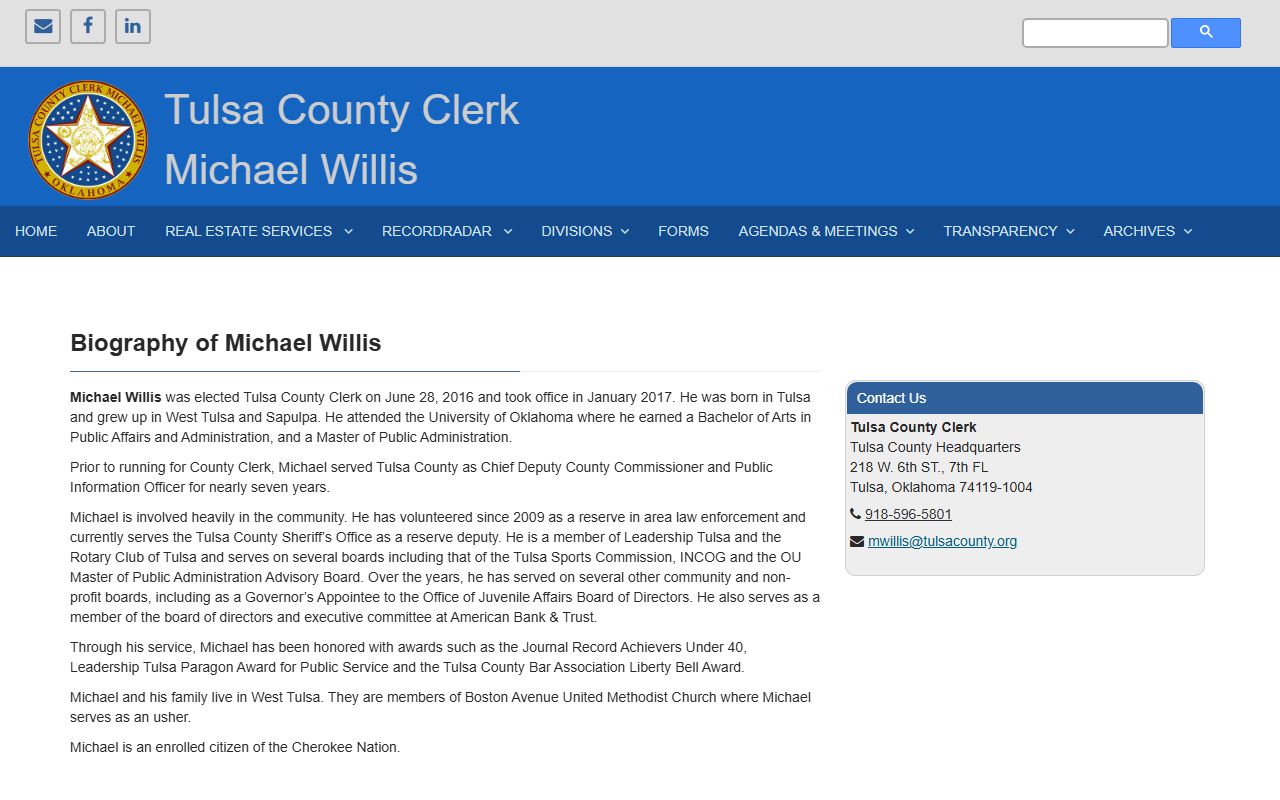
The page lists the office at 218 W. 6th St., 7th Floor, with phone 918-596-5801 and email mwillis@tulsacounty.org. Those are the direct contacts for land records and county open-records questions.