
What Probate Covers in Tulsa County
Probate in Tulsa County is handled in the Probate Division of the Tulsa County District Court. There is no standalone probate court. A single division of the larger trial court hears these matters, and the Court Clerk keeps the files. The work goes well beyond wills. It includes estates of people who died, guardianships of minors and incapacitated adults, conservatorships over property, trust administration, accountings, final decrees, and certain mental-health proceedings.
Each case type follows its own rules, but they share one custodian. The Tulsa County Court Clerk maintains the records, and a district judge assigned to the probate docket signs the orders. That structure keeps estate, guardianship, and trust files in one place even though the subjects differ widely.
People reach probate for many reasons. A family needs to transfer a home after a parent dies. An adult child seeks guardianship of an aging parent. A bank asks to see letters that prove who can act for an estate. All of these run through the same Tulsa County probate process, and all of them leave a court record behind.
The Court Clerk explains local probate filing and access on its probate information page.
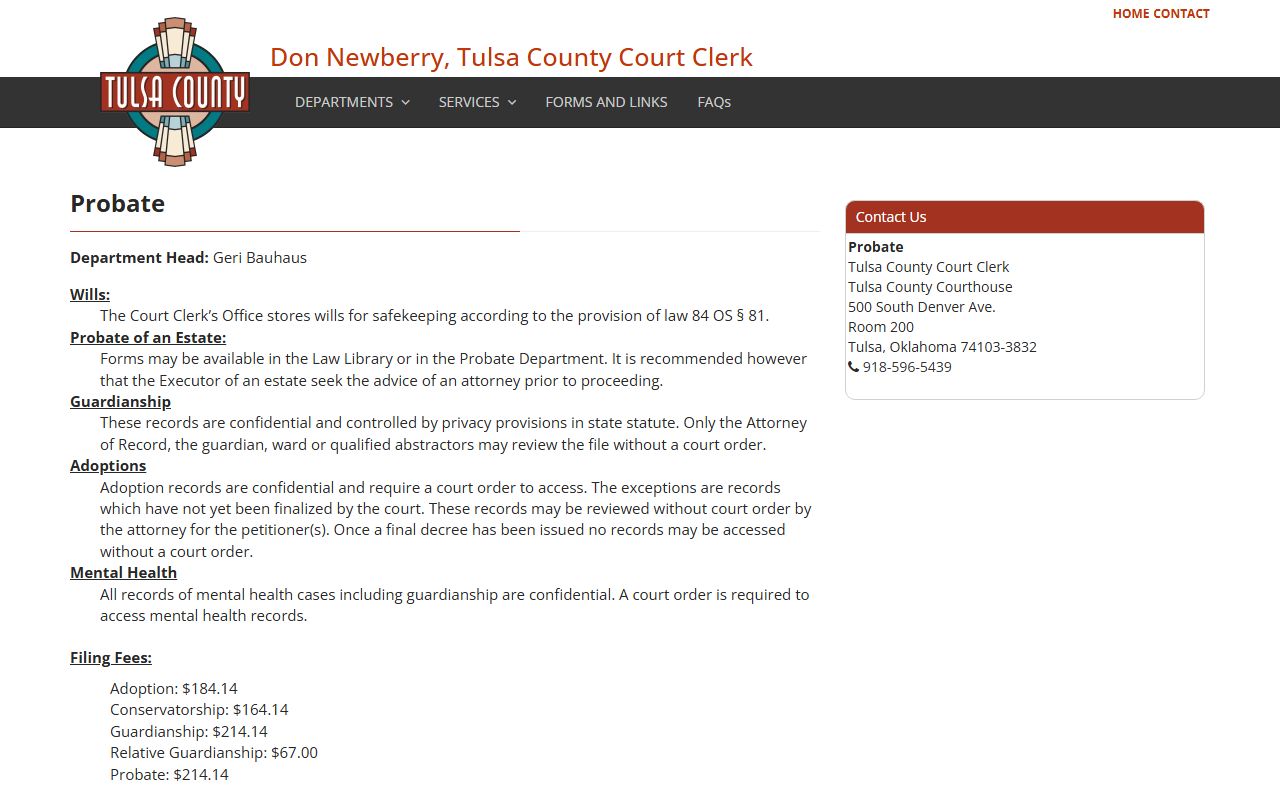
That page lists the current filing fees and the local access caveats, both of which can change, so it is worth checking before a courthouse visit.
Probate Terms Defined
Probate paperwork leans on words that rarely come up in daily life. A few plain definitions make the docket easier to read. These terms appear across estate and guardianship files in Tulsa County.
- Testator
- The person who made the will. Their wishes guide how the estate is distributed.
- Executor
- The person named in a will to carry it out, also called a personal representative.
- Intestate
- Dying without a valid will, so state law decides who inherits.
- Guardianship
- A court arrangement giving one person legal authority over the care of a minor or an incapacitated adult.
- Conservatorship
- A court arrangement giving one person authority over the property and finances of someone who cannot manage them.
How to Search Tulsa County Probate Records
The Oklahoma State Courts Network is the main online channel for probate filings. It carries Tulsa County District Court cases, and probate matters appear under their own case types. A search runs in a few steps.
- Open the OSCN docket search and select Tulsa County District Court.
- Choose the District Court case type Probate or Probate Miscellaneous to narrow the results.
- Search by the deceased person's name, the personal representative, a guardian, a ward, a trust, an attorney, or the case number.
- Open a matching case to review its docket events, hearings, and orders.
- For older files, restricted records, or certified copies, contact the probate unit or visit the Court Clerk downtown.
The same docket tools cover the county's broader filings, and the approach mirrors a general Tulsa County court records search. Note: A public docket may list nonconfidential events while still withholding guardianship, mental-health, or sensitive accounting details that the law protects.
Tulsa County Probate Division Contacts
Phone and in-person contact still matter for probate, especially for certified copies and older files. The probate docket sits with an assigned district judge, and the Court Clerk runs a dedicated probate unit. Use these contacts to confirm a hearing, ask about a filing, or arrange copies.
Probate Division, District Court
Judge Kurt G. Glassco, Courtroom 701
500 S. Denver Ave.
Tulsa, OK 74103
918-596-5320
Court Clerk Probate Unit
Geri Bauhaus, Probate
500 S. Denver Ave., Room 200
Tulsa, OK 74103
918-596-5439
Mon-Fri 8:00 AM - 5:00 PM
For certified copies and mailed requests, the Tulsa County Court Clerk records counter can confirm fees and processing time.
Older probate files are not always at the front counter. The Court Clerk runs a records storage unit at 918-669-8293 and an archives unit at 918-669-8294, and both hold files that no longer sit in the active system. A guardianship from decades back or a long-closed estate may live in storage rather than on the public docket. Calling ahead lets staff pull the file before a downtown trip and tells you whether a certified copy is even available. Note: Files moved to storage or archives can take extra time to retrieve, so allow a few days when an older estate or guardianship is involved.
Tulsa County Probate Filing Fees
Probate filing fees depend on the case type. The Court Clerk publishes set amounts for the common categories, and the full schedule adds statutory charges for certain filings. The figures below reflect the Court Clerk probate page and the office fee schedule.
| Item | Amount |
|---|---|
| Adoption filing | $184.14 |
| Conservatorship filing | $164.14 |
| Guardianship filing | $214.14 |
| Probate summary administration | $135 (plus statutory additions) |
The complete breakdown of civil, criminal, and probate charges appears in the Court Clerk's filing fee schedule. Note: Posted amounts can shift with statutory changes, so confirm the current total with the probate unit before you file.
How Probate Moves Through Court
A probate case follows a recognizable arc. A petitioner files the opening pleading with the Court Clerk, and the matter is assigned to the Probate Division. From there the court handles notices, hearings, appointments, and the orders that move the estate or guardianship along.
The path for a routine estate looks like this: Petition Filed → Notice to Heirs and Creditors → Personal Representative Appointed → Inventory and Accounting → Creditor Period → Distribution → Final Decree. Guardianship and conservatorship cases add reports and reviews, and they may stay open for years while the ward needs protection.
Not every case is simple. Contested estates, real-estate sales, missing heirs, multi-state property, and objections to an accounting can stretch the timeline. Wills and orders may be referenced publicly unless a law seals them. Note: A guardianship or conservatorship can stay open and active for years, so its docket may keep updating long after an ordinary estate has closed.
What Tulsa County Probate Records Show
A probate file is a running history of the case. It opens with the petition and grows as the court adds orders, hearings, and reports. For an estate, the documents trace the property from the moment of death to final distribution. For a guardianship, they track the ward's care and the guardian's reports over time.
Common items in a Tulsa County probate record include the following.
- The will, if one was filed, along with any challenges to it.
- The petition that opened the case and the notice to heirs and creditors.
- The order appointing a personal representative, guardian, or conservator.
- Inventories and accountings listing assets, debts, and distributions.
- Letters testamentary or letters of administration that prove authority to act.
- The final decree closing the estate or the periodic reports in a guardianship.
Document images are not always posted online. The docket may name a filing without offering a link to view it, and certified copies still come from the Court Clerk.
Tulsa County Land and Probate Records
Estate work often touches real estate, and that is where two offices get confused. The Tulsa County Court Clerk holds the probate case file, including the will, the petitions, and the final decree. The separate Tulsa County Clerk records deeds, mortgages, and other land documents. They are different offices with different portals.
This matters when an estate transfers property. The probate court approves the transfer, but the recorded deed lives with the County Clerk's land records. A title search needs the County Clerk. A search for the estate case itself needs the Court Clerk and OSCN. Do not use the land-records portal to find a probate docket.
The split runs the other way too. A land record can show that a property changed hands during an estate, yet it will not hold the will, the inventory, or the judge's orders. Those stay in the probate case file. When a question touches both the estate and the property, expect to check both offices to get the full picture.
Restricted and Confidential Probate Records
Public access stops at several lines in probate. The Court Clerk states that mental-health records require a court order to view. It also notes that records may be reviewed without a court order by the attorney for the petitioners, and that once a final decree has been issued no records may be accessed without a court order. Treat that as a local caveat for specific subcategories rather than a rule over every estate docket.
Other limits come straight from statute. Adoption files are confidential and reach only authorized parties or those with a court order. Juvenile matters are sealed under Oklahoma's confidentiality law. Sensitive accounting details and a ward's personal information may also be shielded inside an otherwise public guardianship case.
Oklahoma's juvenile confidentiality rules live in Title 10A of the Oklahoma Statutes.
That title spells out why certain juvenile and family-linked files never appear on a public docket, even when a related probate case is open.