
Criminal Court Records in Tulsa County
A criminal court record is the case file the court clerk opens when the state charges someone with a crime. In Tulsa County, the Tulsa County Court Clerk keeps these files for the District Court. Don Newberry holds that elected office. His staff log every filing, hearing, and order in the case. The file starts with the charges and grows until the case closes. Felony cases carry a CF case number. Misdemeanor cases carry a CM number. Both become searchable once the charges are filed.
Most criminal cases in the county are heard at the Tulsa County District Court, 500 South Denver Avenue in downtown Tulsa. The District Court is Oklahoma's trial court of general jurisdiction. It handles felonies, misdemeanors, probable-cause filings, and criminal traffic matters brought by state or county officers. City offenses are different. Tulsa Municipal Court at 600 Civic Center handles city ordinance crimes, and those records sit outside the District Court system. The charges a prosecutor files right after an arrest are detailed on the Tulsa County arrest records and court charges page.
Search Tulsa County Criminal Cases
Tulsa County District Court cases are posted on the Oklahoma State Courts Network, known as OSCN. The site is free. It is the official online home for district court dockets across the state. Tulsa County District Court appears in the court list on the OSCN docket search. You can look up a case by number or by name.
- Open the OSCN docket search and choose Tulsa County District Court in the County or Court list.
- Search by last name, or enter a case number such as CF-2025-#### for a felony or CM-2025-#### for a misdemeanor.
- Narrow the results with a case type, like Criminal Felony or Criminal Misdemeanor, and add a filed-date range.
- Open the case to read the docket, the counts, and the disposition.
- Request a certified copy from the Court Clerk when you need one for legal use.
OSCN does not cover city tickets. A statewide name search can also pull cases from other Oklahoma counties, so confirm the county on each result. For older or imaged files that are not online, the Court Clerk's criminal and traffic counter at 918-596-5471 can point you to records storage or archives. A broader walkthrough of every record type lives on the Tulsa County court records page.
Note: A name search on OSCN can return several people with similar names, so confirm the date of birth and case details before relying on any match.
Stages of a Tulsa County Criminal Case
A criminal case moves through set stages. Each one leaves a mark in the record. Reading the docket in order tells you where the case stands and what comes next. The file shows the date and result of every step.
Case flow: Charges Filed › Arraignment › Pretrial and Motions › Plea or Trial › Disposition › Sentencing
Felony cases add a preliminary hearing before trial. At that hearing a judge decides whether enough evidence exists to bind the case over. Misdemeanors skip that step. Bond, counsel, and plea questions are usually settled early, then the case heads toward a plea deal or a trial.
What Tulsa County Criminal Records Show
Each criminal file holds a standard set of fields. The same details appear whether the charge is a felony or a misdemeanor. Knowing the fields helps you read a docket quickly and spot the outcome.
| Field | What It Shows |
|---|---|
| Case Number | The court ID for the case, with a prefix like CF or CM, the filing year, and a sequence number. |
| Defendant | The person charged, listed with the assigned judge, the courtroom, and the lawyers on each side. |
| Charges | Each count filed by the state, with the statute cited and the offense level. |
| Plea | The defendant's formal answer to each count, such as guilty, not guilty, or no contest. |
| Bond | The amount and type of bond set for release, plus any warrant or recall tied to the case. |
| Disposition | The final result of each count, such as a conviction, dismissal, or acquittal. |
| Sentence | The penalty ordered after a conviction, which may include jail, probation, fines, and costs. |
Reading Tulsa County Criminal Dispositions
The disposition is the bottom line of a charge. It tells you how that count ended. Sentences appear only after a conviction. A single case can mix outcomes, with one count dismissed and another resolved by a plea. These terms come up most often in a Tulsa County criminal record:
- Guilty plea or verdict: the defendant admits the charge or a jury or judge finds guilt.
- No contest (nolo): the defendant does not fight the charge but does not admit guilt.
- Dismissed with prejudice: the count is dropped and generally cannot be refiled.
- Dismissed without prejudice: the count is dropped but may be refiled if allowed.
- Deferred sentence: sentencing is delayed while the defendant meets court terms, which can later clear the conviction.
A sentence line lists the punishment for each count. It may show jail or prison time, a suspended term, probation, fines, court costs, and restitution. Probation places the person under supervision in the community instead of custody.
Charges vs. Convictions
Being charged is not the same as being convicted. A criminal court record can show charges that were later dropped, dismissed, or ended in acquittal. A charge is only an accusation. A conviction is a finding of guilt by plea or verdict.
| Charge | Conviction | |
|---|---|---|
| Stage | Accusation by the state | Verdict or plea of guilt |
| Burden of Proof | Probable cause | Beyond a reasonable doubt |
| Public Record | Yes | Yes |
Who Files Tulsa County Criminal Charges
The District Attorney for District 14 files state criminal charges in Tulsa County District Court. District Attorney Steve Kunzweiler leads that office at the Tulsa County Courthouse, 500 South Denver Avenue, Suite 900, Tulsa, OK 74103. The main line is 918-596-4805, and the office email is districtattorney@tulsacounty.org. Hours run 8:00 a.m. to 5:00 p.m. on weekdays. The office reviews arrests, decides the formal counts, and carries the case through trial or plea.
The Tulsa County District Attorney posts its contact details and divisions on its county homepage.
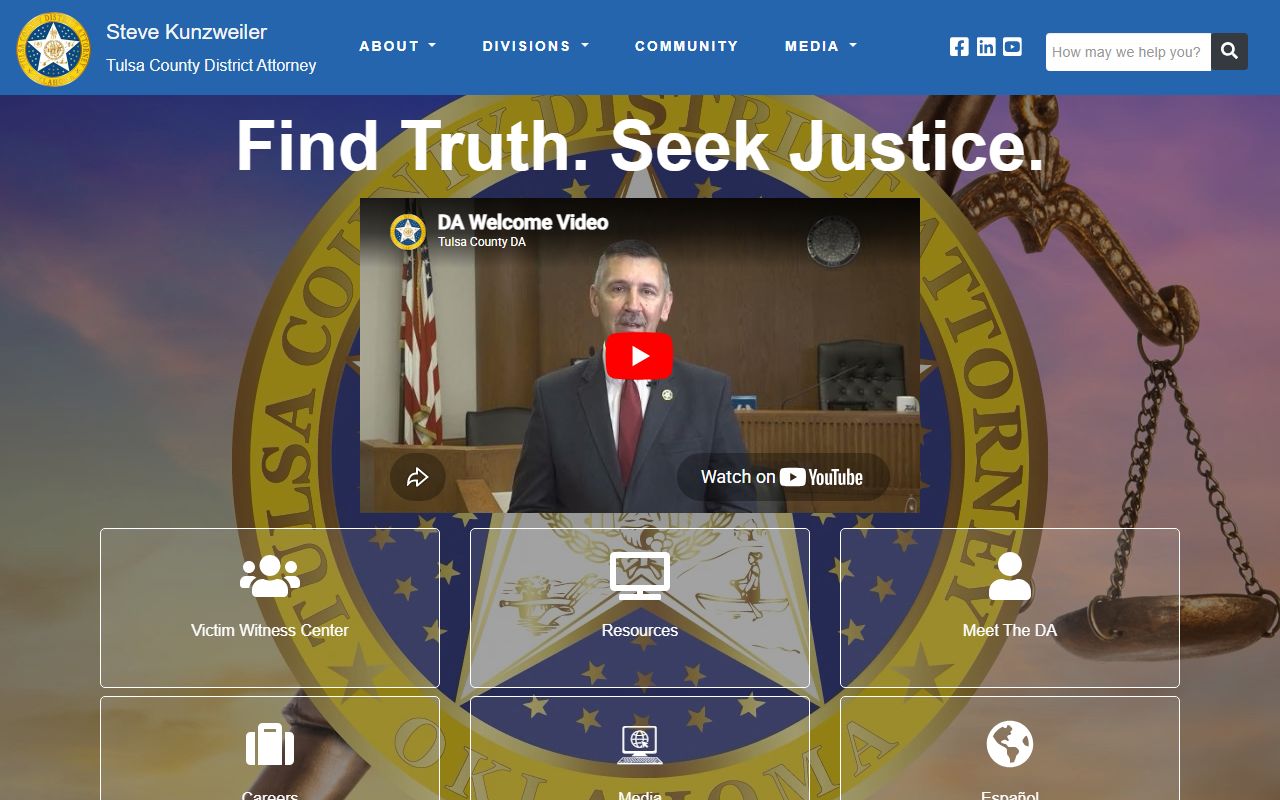
The page confirms the downtown office handles felony and misdemeanor prosecutions for the county. It also runs the Victim Witness Center and a juvenile division, and it supports alternative court tracks such as misdemeanor diversion, Veteran's Court, and Women in Recovery.
The Oklahoma District Attorneys Council lists District 14 and its staff contacts on the state District 14 page.
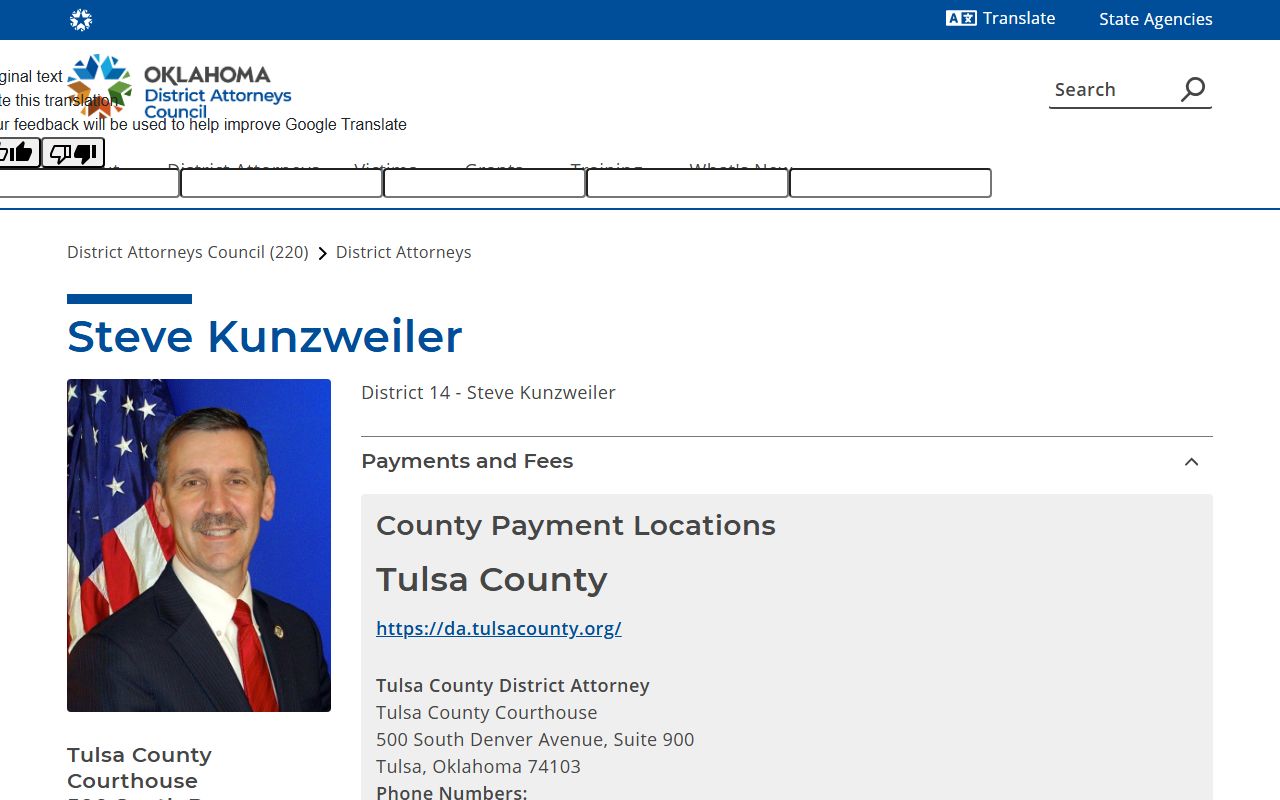
That state listing shows the supervision, victim-witness, and juvenile contacts that back the local prosecution work in Tulsa County criminal court records.
Defendants who cannot afford a lawyer may receive appointed counsel. Tulsa County runs its own Public Defender office at 423 South Boulder Avenue, Suite 300, Tulsa, OK 74103, reachable at 918-596-5530. The statewide Oklahoma Indigent Defense System does not serve Tulsa County because the county funds its own office. A judge appoints the public defender for eligible defendants; you do not hire one directly.
The county profiles the office on its Tulsa County Public Defender page.
That page explains how appointed defense supports people facing charges in Tulsa County criminal court records, from arraignment through sentencing.
Note: The docket names the prosecutor and defense attorney on each case, which helps confirm whether a defendant had appointed or private counsel.
Specialty Courts in Tulsa County
Not every criminal case follows the standard path. Tulsa County runs specialty dockets that focus on accountability and treatment. The Tulsa County Domestic Violence Court is an integrated court built to improve the response to intimate-partner violence, protective-order violations, and stalking. It covers both misdemeanor and felony dockets. The court adds judicial monitoring, regular review hearings after sentencing, and coordination across related criminal, protective-order, and family cases.
The county is also a designated Mentor Court through the federal Office on Violence Against Women, which means it guides other jurisdictions building similar programs. Several other tracks may handle eligible cases through supervision or treatment instead of ordinary prosecution:
- Misdemeanor diversion for lower-level offenses.
- Veteran's Court for qualifying veterans.
- Women in Recovery as an alternative to incarceration.
- Other accountability programs listed by the court's Alternative Court Programs office.
A case routed to one of these dockets still appears in the criminal record, but the docket entries reflect the program terms and review hearings.
Sealed vs. Expunged Criminal Records
Some Tulsa County criminal records can be hidden from public view. Oklahoma allows eligible arrest and court records to be sealed through a district-court expungement. Once sealed, the public should not expect to find the case on OSCN. The terms sealed and expunged are close but not identical.
| Sealed | Expunged | |
|---|---|---|
| Visibility | Hidden from public search | Treated as though it never existed |
| Law Enforcement | Limited access remains | Very limited access |
| Eligibility | Set by 22 O.S. § 18 categories | Granted by court order under 22 O.S. § 19 |
A Tulsa County expungement starts as a District Court petition under 22 O.S. sections 18 and 19. The person confirms eligibility, files where the case record exists, and serves the agencies that hold criminal-history data. If the judge grants the petition, the signed order goes to those agencies and the public record is sealed from ordinary inspection. The order does not erase every government use of the data.
The full expungement statute sits in the Oklahoma Statutes title index on OSCN's Title 22 page.
That index lets you read the eligibility categories and the sealing procedure that control whether a Tulsa County criminal record stays public.
Public Access to Tulsa County Criminal Records
Oklahoma treats court files as open records unless a specific law closes them. The Open Records Act sets the baseline, and OSCN is the official window into Tulsa County District Court dockets. When a record is not online, the Court Clerk's counters and the records-request process fill the gap.
Key Statutes:
Oklahoma Statutes Title 51 § 24A.1 - the Open Records Act makes public-body records open for inspection and copying unless a law makes them confidential.
Oklahoma Statutes Title 10A § 2-6-102 - juvenile court records are confidential except for limited statutory exceptions and authorized releases.
For sheriff booking records, incident reports, or body-camera video, the Tulsa County Sheriff's Office runs its own open-records process by mail or email. For city tickets and city warrants, Tulsa Municipal Court holds those files separately.
Background Check Considerations
A casual OSCN search is not the same as a regulated background check. Employers, landlords, and licensing boards must follow federal and state rules when they use criminal records for a decision. A formal background report draws on certified state criminal-history data, not a quick public docket scan. The two serve different purposes.
Important: This site is not a consumer reporting agency under the Fair Credit Reporting Act, and its information cannot be used for credit, employment, tenant, or other FCRA-regulated decisions.
Restricted Criminal Court Records in Tulsa County
Public access has limits. Several categories of Tulsa County criminal matters are not ordinary searchable dockets. Juvenile delinquent, deprived, and in-need-of-supervision cases are confidential by law. Sealed and expunged cases drop off the public portal once an order is entered. Mental-health proceedings tied to a case require a court order to view.
Public copies may also redact private details. Social Security numbers, financial account numbers, minor names, protected addresses, and victim-safety information are commonly blacked out. Some filings simply are not posted online, even in open cases, and must be inspected at the courthouse. When a record is sealed or withheld, the public docket either omits it or shows only a limited entry.