
How to Search Tulsa County Court Records
The Oklahoma State Courts Network, known as OSCN, is the official online home for Tulsa County District Court cases. Tulsa County District Court appears in the court dropdown, so a searcher can limit results to local cases. The system accepts a case number, a party name, a case type, or a date range. It also offers a traffic-citation search for tickets filed in District Court. The main entry point is the OSCN Docket Search form.
A little preparation helps. Have the full name spelled correctly, or the case number in its prefix-year-number format. Knowing the case type narrows a long list fast. The OSCN Court Records landing page also links daily docket reports, a case-number lookup, and a search for counties that are not on OSCN.
The OSCN Docket Search form is the same screen for every Oklahoma court, with Tulsa County selectable in the dropdown.
The screen below comes straight from the OSCN Docket Search page.
From here you choose the court, then enter a name or case number to pull a Tulsa County District Court docket. Follow the steps below to run a clean search.
- Open the OSCN Docket Search form in a browser.
- Choose Tulsa County District Court in the County or Court dropdown to keep results local.
- Enter the case number if you have it, using the full format such as CF-2025 for a felony or CM-2025 for a misdemeanor.
- To search by person, type the last name, then add a first or middle name and a party type to shrink the list.
- Apply a case-type filter like Criminal Felony, Family and Domestic, Probate, or Small Claims when the record type is known.
- Use the filed or closed date ranges to separate current cases from older ones.
- For a state or county traffic ticket, use the District Court traffic-citation field instead of the case-number box.
Tulsa County Court Records Search Fields
Each field on the OSCN form serves a different kind of lookup. Party fields drive name searches, while case-type and date fields trim broad results. The citation field works only for District Court traffic tickets and does not reach Tulsa Municipal Court citations. The table lists the fields captured from the live form.
| Field Label | Type | Required | Notes / Format |
|---|---|---|---|
| County or Court | Dropdown | No | Includes All Oklahoma Courts, Tulsa County District Court, and the appellate courts. |
| Case Number | Text | No | Prefix-year-number format, for example CF-2014-1. |
| Last Name | Text | No | Party name search; pair with first or middle name. |
| Party Type | Dropdown | No | Defendant, Plaintiff, Petitioner, Respondent, Attorney, Judge, and many more. |
| District Court Case Type | Dropdown | No | Criminal Felony, Family and Domestic, Probate, Small Claims, Protective Order, Traffic, and others. |
| Cases Filed After / Before Date | Date | No | Format shown as mm/dd/yyyy. |
| Citation Number | Text | No | District Court only; does not search municipal citations. |
Types of Tulsa County Court Records
The District Court files many kinds of cases, and each carries a two-letter prefix on the docket. The prefix tells you the case category before you open it. Some categories, such as juvenile and adoption, are kept off the public portal by law. Most civil, criminal, family, probate, and traffic dockets show parties, events, hearing dates, and dispositions unless a judge has sealed them.
These are the common Tulsa County District Court case types and their codes.
- CF and CM: criminal felony and criminal misdemeanor cases prosecuted by the District Attorney.
- CJ, CS, and CV: civil suits, with CJ for relief over $10,000, CS for civil claims under that line, and CV for special civil matters.
- FD: family and domestic cases such as divorce, paternity, child support, and protective orders.
- PB and PO: probate estates and guardianships, and protective-order dockets.
- ML, SC, and SW: marriage licenses, small claims under $10,000, and search-warrant records.
- TR and TRTU: state or county traffic complaints and criminal traffic cases filed in District Court.
What Tulsa County Court Records Show
A public OSCN case summary packs a full case onto one screen. The header carries the court name, case number, style, and case type. Below that runs the docket, a dated list of every filing and order. Criminal cases add counts and statute citations. The table breaks down the fields a typical Tulsa County docket returns.
| Field | What It Shows |
|---|---|
| Case Number | The court, prefix, year, and sequence that identify the file. |
| Style / Caption | The parties as named, such as State of Oklahoma versus a defendant. |
| Filed Date and Case Type | When the case opened and which category it falls under. |
| Parties and Roles | Plaintiff, defendant, petitioner, respondent, and their attorneys. |
| Judge | The judicial officer assigned to the case. |
| Counts and Charges | For criminal cases, each charge with its statute reference. |
| Docket Entries | Filings, minute orders, and scheduled hearing dates in time order. |
| Disposition | The final outcome of the case or a single charge. |
| Financial Entries | Court costs, fines, and restitution where entered. |
| Document Links | Links to filed images when a document is available online. |
Documents do not always open from the docket. Many older filings were never imaged, and some are withheld by rule. When a link is missing, the file may still be viewed or copied at the courthouse. Reading the dated events alongside the disposition is the surest way to learn where a case stands. The same docket layout appears across every Tulsa County District Court case type.
Note: Docket events and minute entries are summaries, so the certified record at the Court Clerk office controls if an online entry and the official file disagree.
Public Access Laws for Tulsa County Court Records
Oklahoma treats government records as open by default. The Oklahoma Open Records Act, found at 51 O.S. Section 24A.1 and the sections that follow, says public-body records are open for inspection and copying unless a specific law makes them confidential. The full statute text sits on the state courts site. You can read the Oklahoma Open Records Act document and confirm the citation against the source.
The image below shows that statute as published on OSCN.
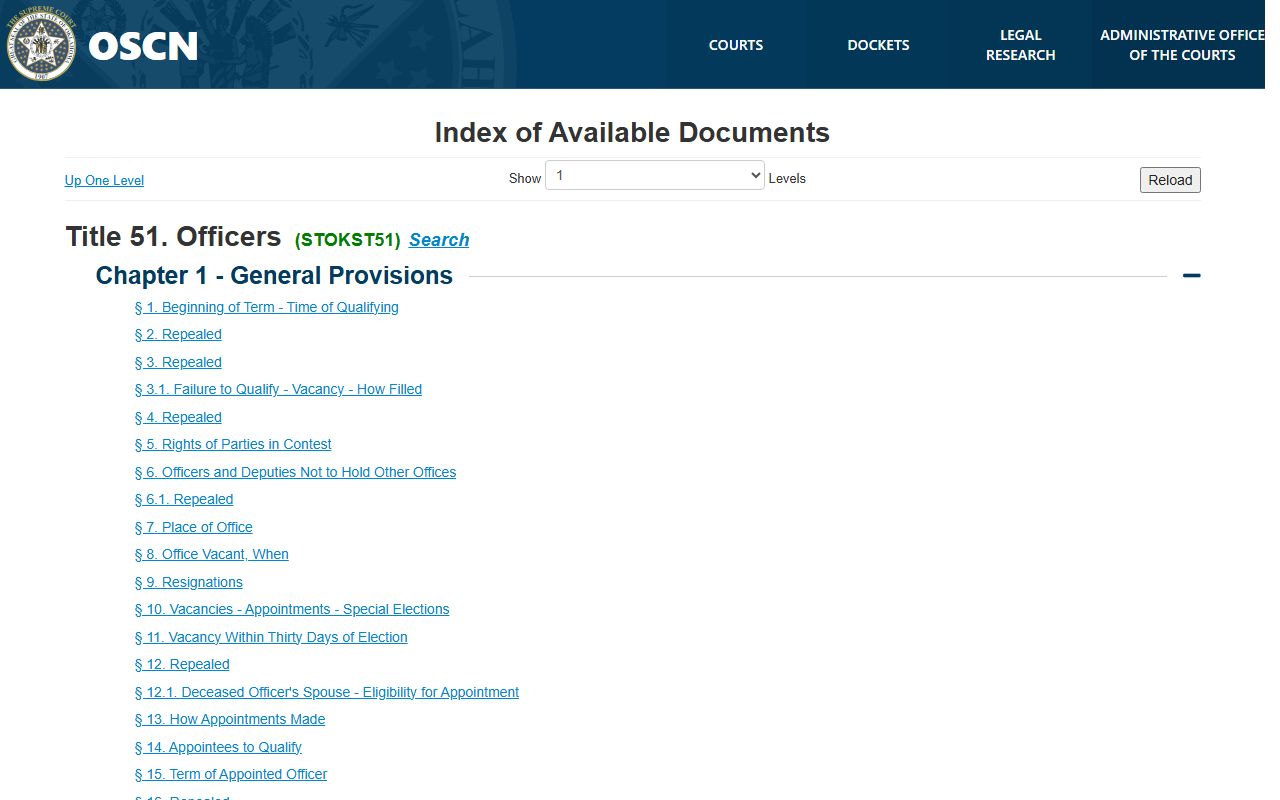
The Act also sets out copying and search fees at 51 O.S. Section 24A.5, so an office may charge for copies and certain direct search work. The whole title is browsable from the Oklahoma Open Records Act title index, which lists every section in order.
The title index makes it easy to jump between related sections.
Not every record follows the open-records rule. Driving histories are a clear example. Access to a driver record is limited to the driver or an authorized requester under 47 O.S. Section 6-117, which keeps casual lookups of another person's driving history off the table.
That driver-record statute is published in its own title on OSCN.
A driving history is a state record held by Service Oklahoma, not a District Court file, so it follows separate access rules. Court traffic cases, by contrast, stay on the public docket. The full title index for that statute lives at the Oklahoma driver-record access statute index.
Sealed and Confidential Tulsa County Records
Some Tulsa County cases never appear on the public portal. Juvenile deprived, delinquent, and in-need-of-supervision files are confidential by law. Adoption filings are closed to the public. Mental-health case records require a court order before anyone outside the case can view them. Sealed and expunged records also drop out of public view once a judge signs the order.
Expungement runs through the District Court. A person petitions under 22 O.S. Sections 18 and 19, naming the arrest or case and showing eligibility. The court reviews the request and any objections. If the judge grants it, the signed order goes to the agencies that hold the record, and the public-facing file is sealed from ordinary inspection. The statutes are browsable at the Oklahoma expungement statute index.
Public copies can also be redacted. Social Security numbers, full account numbers, a minor's name, protected addresses, and victim-safety details are commonly blacked out even on an otherwise open file.
Note: A record missing from OSCN is not always sealed, since many older or imaged files were simply never posted online and still exist at the courthouse.
Paying Tulsa County Court Costs Online
Court records often carry a balance for fines, fees, or restitution. Oklahoma runs a separate payment system for that. The OSCN e-payments search lets a payer find a case by county plus a case number, a citation number, or a payment-plan number, then move through a billing workflow.
The search screen is shown below.
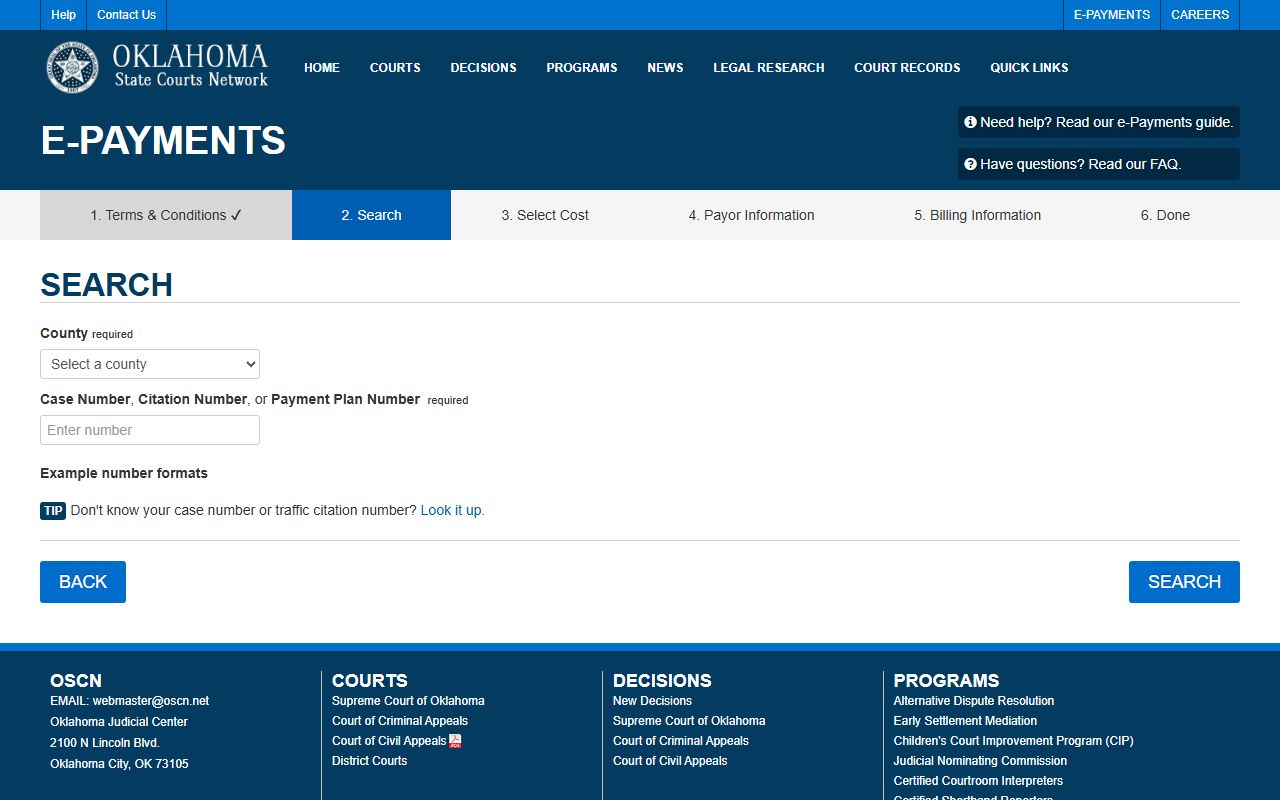
After a match, the system walks through terms, cost selection, payor and billing details, and a confirmation step. Select Tulsa for a Tulsa County District Court balance. This tool handles District Court costs, not Tulsa Municipal Court tickets, which use the city payment portals instead. Reviewing the docket first confirms which costs are open before you pay.
Requesting Records From the Court Clerk
When a file is old, imaged, sealed by request, or simply not online, the Tulsa County Court Clerk is the next stop. The office sits on the second floor of the courthouse in downtown Tulsa and keeps the records of every District Court case. Walk-in visitors can inspect files and order certified copies, which courts and agencies require for official use. The court dockets behind these files are explained on the Tulsa County court dockets page.
Calling the right counter saves a wasted trip. The criminal and traffic division answers at 918-596-5471, while records storage handles older files at 918-669-8293 and archives at 918-669-8294. Family, probate, and small-claims counters each have their own lines. The Tulsa County Court Clerk site lists divisions, forms, and fees.
Tulsa County Court Clerk
500 S. Denver Ave., Room 200
Tulsa, OK 74103
918-596-5420
Mon-Fri 8:00 AM - 5:00 PM
The Court Clerk also keeps a criminal and traffic page describing state traffic tickets, search warrants, property recovery, and appeals from municipal rulings. Detailed filing categories sit on the criminal and traffic division page.
Sheriff and Municipal Court Record Channels
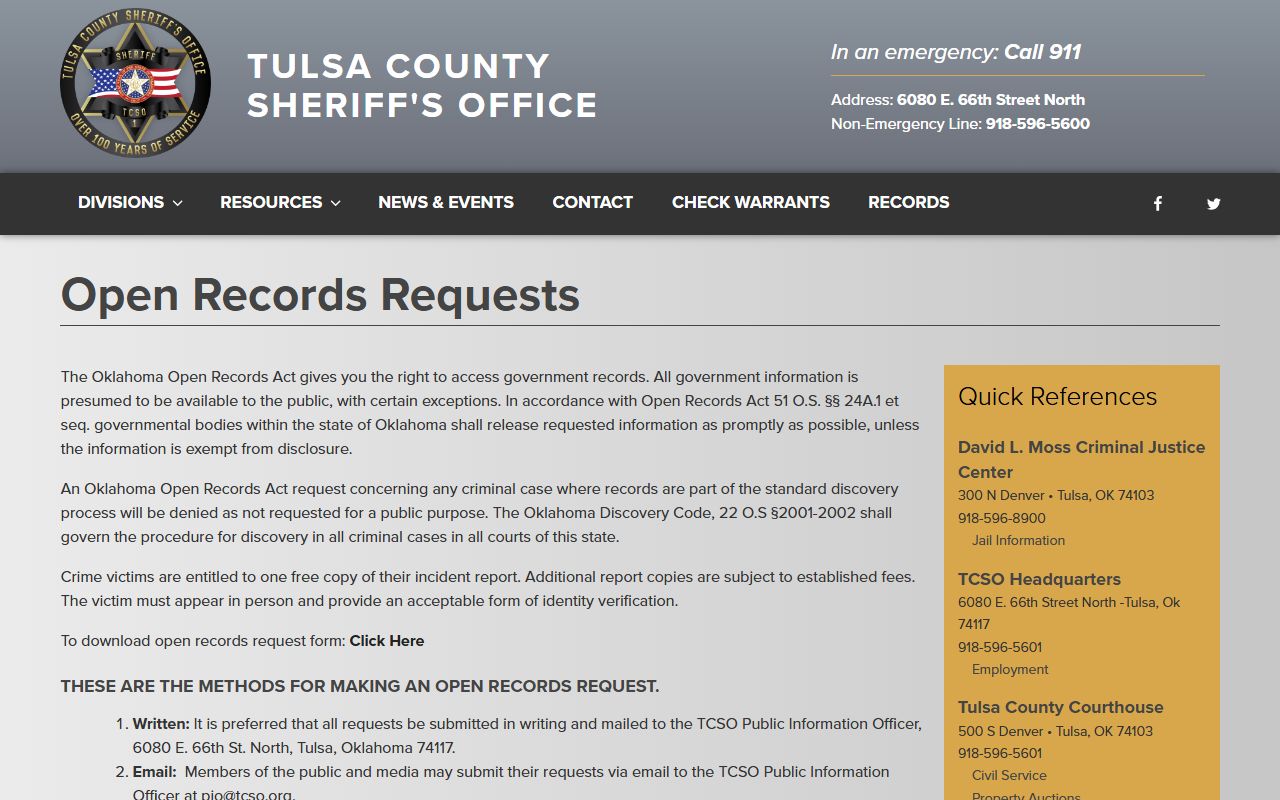
Court files are only part of the picture. Booking records, incident reports, body-camera video, and jail records belong to the Tulsa County Sheriff's Office, not the Court Clerk. The Sheriff takes open-records requests by U.S. mail or email only, with hand delivery not allowed. Requests go to the Public Information Officer or to pio@tcso.org, and a fee schedule with redaction rules applies. The methods are posted on the TCSO public-records request page.
The request methods and fees appear on the page shown below.
City cases follow a different track. Tickets, ordinance violations, and municipal misdemeanors inside the City of Tulsa run through Tulsa Municipal Court, which keeps its own records and warrants. Those cases do not appear on OSCN. The charges and outcomes inside a state criminal file are covered in more depth on the Tulsa County criminal court records page.
Sorting the office to the record is the whole job. District Court files start on OSCN and finish at the Court Clerk. Land and county-government records belong to the County Clerk. Sheriff and city records each have their own request channel.