
Tulsa County District Court Overview
Oklahoma uses District Courts as its trial courts of general jurisdiction. A district judge can hear both civil and criminal matters. The Tulsa County District Court handles the county's state cases at 500 S. Denver in downtown Tulsa. The main court number is 918-596-5000.
The court covers a wide field of cases. Civil disputes, felony and misdemeanor prosecutions, divorce and custody, probate, small claims, protective orders, and traffic filed by information all land here. Presiding Judge David Guten leads the bench. Court Administrator Kim Hall runs court operations from Room 637 and can be reached at 918-596-5400.
The courthouse sits in downtown Tulsa's Civic Center area near Denver Avenue. Most counters and courtrooms are inside the main building, while the juvenile division works from a separate site. The Court Clerk keeps the official files on the second floor. A records seeker usually starts online and finishes at the courthouse for certified copies or older files.
The screen below is the official District Court homepage.
The court posts its address, presiding judge, and quick links on the Tulsa County District Court homepage.
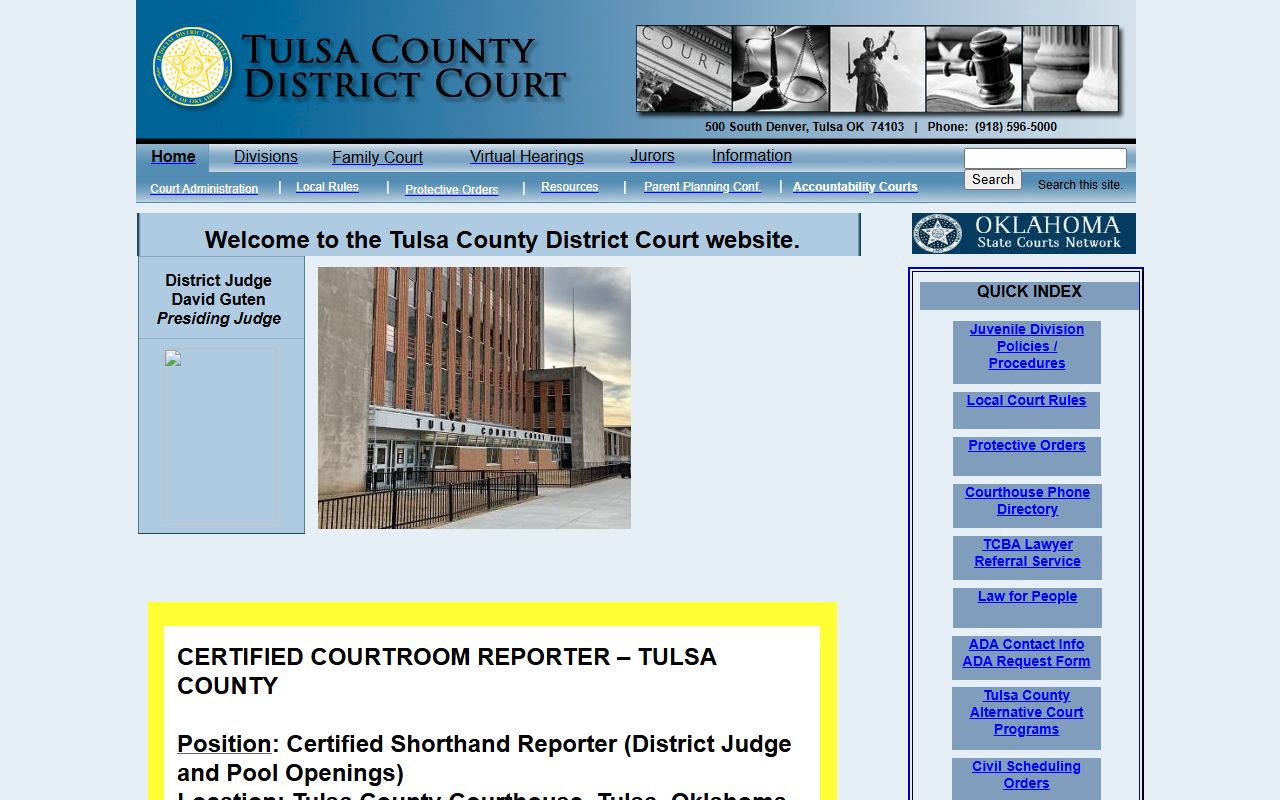
The homepage links local rules, the phone directory, ADA information, and accountability courts. Those tools cover most public questions about the court.
Tulsa County Courthouse
Presiding Judge: David Guten
500 S. Denver Ave.
Tulsa, OK 74103
918-596-5000
Court Administration, Room 637, 918-596-5400
Mon-Fri 8:00 AM - 5:00 PM
Tulsa County District Court Judges and Dockets
Each district judge is assigned a docket, a courtroom, and a direct phone line. The court phone directory is the best current list of those assignments. The table below reflects the directory effective April 6, 2026. Special judges also handle small claims, family, juvenile, guardianship, arraignments, bond, and mental-health matters.
| Judge | Docket | Courtroom | Phone |
|---|---|---|---|
| David Guten (Presiding) | Criminal B | 413 | 918-596-8606 |
| Doug Drummond | Criminal E | 408 | 918-596-5044 |
| Kurt G. Glassco | Probate | 701 | 918-596-5320 |
| Kevin Gray | Civil B | 501 | 918-596-5300 |
| Kelly Greenough | Civil F | 713 | 918-596-5375 |
| Richard Hathcoat | Civil E / Family D | 631 / 601 | 918-596-5390 / 918-596-5334 |
| Sharon Holmes | Criminal D | 506 | 918-596-5200 |
| Michelle B. Keely | Criminal F | 401 | 918-596-5360 |
| William D. LaFortune | Civil C | 513 | 918-596-5415 |
| Dawn Moody | Criminal C | 406 | 918-596-8443 |
| Rebecca Brett Nightingale | Civil A | 708 | 918-596-5350 |
| Tracy Priddy | Civil D | 508 | 918-596-5340 |
| Caroline Wall | Civil G | 706 | 918-596-5310 |
Assignments change over time, so the directory is the source to trust for a current docket. A docket label tells you the division and the judge. Knowing the courtroom helps when you visit for a hearing.
Note: The phone directory is effective April 6, 2026, so confirm a judge or docket assignment against the latest version before relying on a courtroom or phone number.
Divisions of the Tulsa County District Court
The court splits its work into divisions, and each one handles a distinct kind of case. Sorting a matter to the right division speeds filing and records requests. Most divisions sit in the downtown courthouse, but juvenile cases have their own location. The breakdown below covers the main divisions.
- Civil handles noncriminal disputes outside family, juvenile, and probate, such as contracts and money judgments.
- Criminal handles state prosecutions, from arraignment through trial, sentencing, and probation hearings.
- Family handles divorce, legal separation, paternity, child support, custody, and protective orders.
- Juvenile handles deprived, delinquent, and in-need-of-supervision cases at 315 S. Gilcrease Rd., 918-596-5913.
- Probate handles estates, guardianships, conservatorships, and trust administration.
- Small Claims handles money and damage claims under $10,000 and many landlord-tenant disputes.
The juvenile division works out of the Gilcrease Road location rather than the main courthouse. Probate matters route to Judge Glassco on the probate docket. Each division keeps its files through the Court Clerk counters.
Division matters more than it looks. A single family may have a criminal case, a protective order, and a divorce running at once, each on a different docket. The court coordinates related criminal, protective-order, and family cases to avoid conflicting orders. Sorting the matter to the right division and judge is the first step when you request a file or attend a hearing.
District Court vs Municipal Court
Tulsa County has two main court levels for local matters. The District Court is the general trial court for state cases. The Tulsa Municipal Court is the limited city court for ordinance matters. Knowing which one holds a case decides where you search and pay. The table compares the two.
| District Court | Municipal Court | |
|---|---|---|
| Jurisdiction | State and county cases of general jurisdiction | City of Tulsa ordinance matters only |
| Case Types | Felony, misdemeanor, civil, family, probate, state traffic | City traffic, parking, code, municipal misdemeanors |
| Location | 500 S. Denver, Tulsa | 600 Civic Center, Tulsa |
| Records Access | OSCN docket search and the Court Clerk | Tulsa Municipal Court records, 918-596-1625 |
A city parking ticket or a Tulsa ordinance violation stays at Municipal Court. A felony, a divorce, or a state traffic case filed by information belongs to the District Court. The two systems keep separate records and warrants.
How a Case Moves Through the System
A Tulsa County case starts at the District Court and can climb to the state appellate courts. Oklahoma uses two high courts, one for civil appeals and one for criminal appeals. The Court of Civil Appeals takes many civil appeals assigned by the Supreme Court. The flow lines below show each path.
Criminal flow: Arrest › First Appearance › Information or Indictment › Arraignment › Preliminary Hearing › Trial › Sentencing › Court of Criminal Appeals
Civil flow: Petition Filed › Answer › Discovery › Trial › Judgment › Court of Civil Appeals › Oklahoma Supreme Court
Civil appeals go to the Oklahoma Supreme Court, with many assigned down to the Court of Civil Appeals. Criminal appeals go to the Oklahoma Court of Criminal Appeals. Daily dockets and case events appear online for active District Court cases through the state system, as shown on the Tulsa County court dockets page.
Local Rules and Court Administration
The District Court maintains its own local rules and a bond schedule. The local-rules page was last updated October 23, 2025, with the criminal and traffic rules revised on that date. Separate rule sets cover general, civil, criminal, traffic, family, juvenile, and probate practice. An Appendix A bond schedule sets standard bond amounts.
Court administration handles the bench's scheduling, jury operations, and building services. Court Administrator Kim Hall works from Room 637 at 918-596-5400. Pointing readers to the local rules is better than restating every deadline, since the rules change over time. Full case files and certified copies come from the Tulsa County Court Clerk, which keeps the official record of every District Court case.
The bond schedule in Appendix A sets standard amounts for many charges, which speeds the early stages of a criminal case. Readers should treat the rules as living documents and check the date posted on the page. A 2026 phone directory and a 2025 rules update show the court keeps its public materials current.
The court also publishes a page for Court Clerk contacts and family-relations filings.
The court links those details on the District Court Court Clerk page.
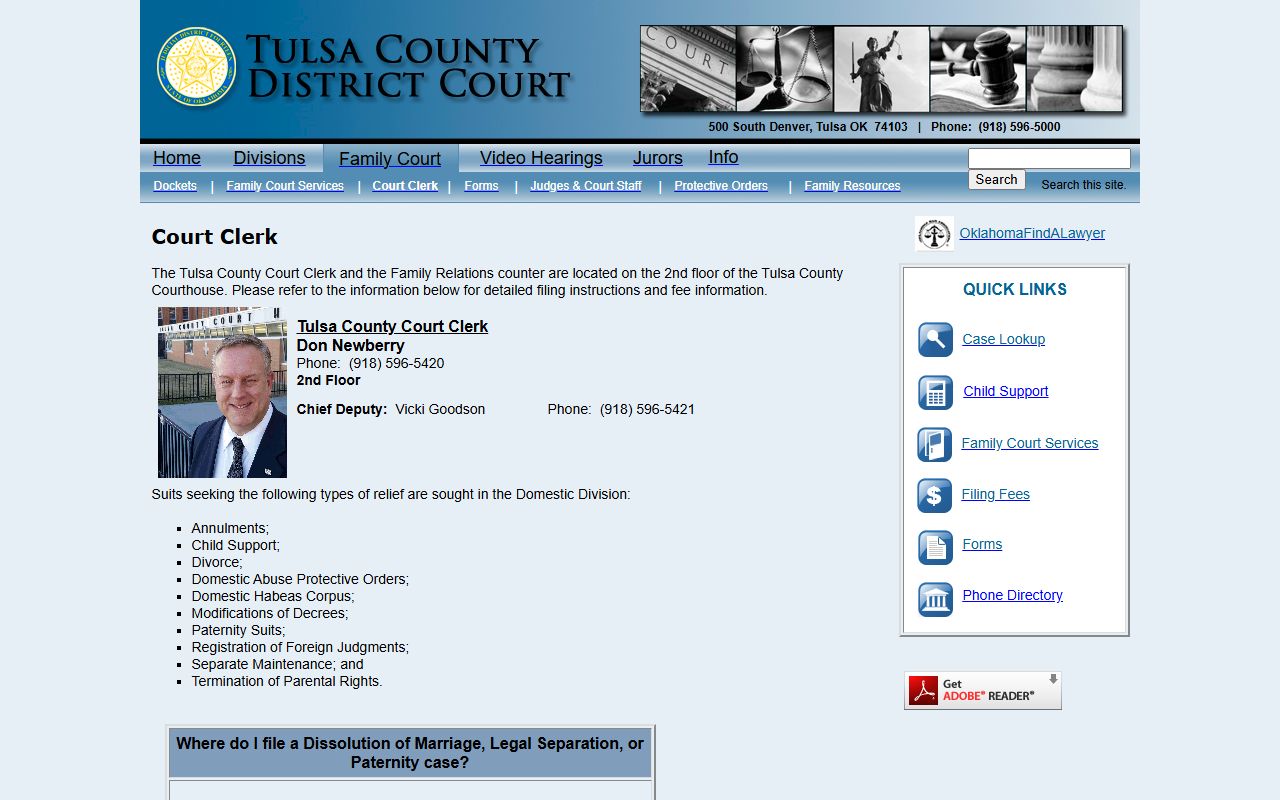
The page lists the Court Clerk phone, the family-relations counter, and the categories of domestic cases the court accepts. It is a quick way to confirm which counter handles a given filing before a courthouse trip.
Tulsa County District Court Jury Service
Jurors report to the Jury Assembly Room, Room 212, in the courthouse. The District Court pays $50 per day plus mileage figured from the juror's home zip code. Service can run from 8:30 a.m. to 5:00 p.m. Business casual is the minimum dress standard, and shorts, tank tops, and bare feet are not allowed.
Jurors can reschedule up to six months from the summons date and may postpone the first appearance once by phone at 855-316-4847 or by mail to Room 637. The court warns that it will never contact jurors to ask for a Social Security number or date of birth, since such requests are likely phishing. The assembly room has Wi-Fi, and vending machines and an ATM are in the building.
Note: The District Court never calls jurors to request a Social Security number or date of birth, so treat any such call as a possible scam and verify through official court numbers.
Accessibility and Interpreter Services
The courthouse is set up for accessible visits. Physically challenged jurors who use wheelchairs may enter by ramp at the library-level entrance. ADA accommodations are linked from the District Court homepage. The building is nonsmoking throughout.
The court also coordinates language interpreters for hearings. Keith Magrady serves as the Interpreter Coordinator and can be reached at 918-596-5980. Arranging an interpreter in advance keeps a hearing on schedule. These services apply across the civil, criminal, family, and probate dockets.
Tulsa County Accountability Courts
The District Court runs problem-solving dockets alongside ordinary cases. The Tulsa County Domestic Violence Court is an integrated, specialized court for intimate-partner violence, protective-order violations, and stalking. It includes both misdemeanor and felony dockets and provides ongoing judicial monitoring after sentencing. Tulsa County is also a national Mentor Court through the Office on Violence Against Women.
The accountability-courts page describes these specialized dockets.
Details appear on the Tulsa County accountability courts page.
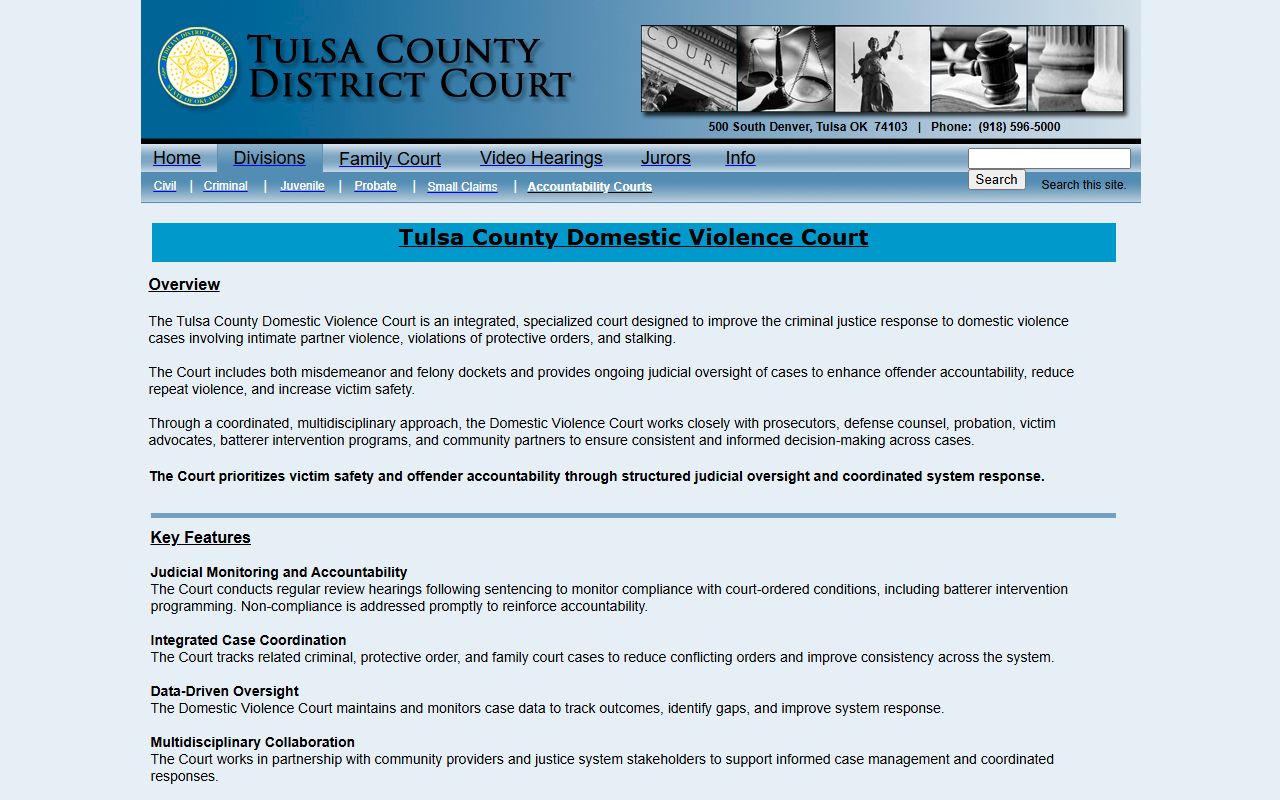
The court also links Tulsa County Alternative Court Programs at tcacp.org, with an Alternative Courts line at 918-596-8595. Diversion, Veteran's Court, and Women in Recovery give eligible defendants a treatment-based path instead of ordinary prosecution.