
Tulsa County Arrest Records and Court Charges
An arrest record is the record of the arrest itself. It shows who made the arrest, the booking, and the reason a person was taken into custody. In Tulsa County, the arresting agency and the jail hold that booking side. The court charge record is separate. Once someone is arrested, the District Attorney reviews the case and files the formal counts with the Tulsa County Court Clerk. Those filed counts become the charge record. Arrest records and charge records work together, but they begin in different offices.
Keep the two apart when you search. The booking and custody detail, such as the current jail roster, sits on the Tulsa County inmate records page. The court charges after arrest are tracked through the case docket. The full case file, with pleas, hearings, and the final outcome, is covered on the Tulsa County criminal court records page. This page focuses on the path from arrest to filed charges and on what each charge means.
How to Search Tulsa County Arrest Records
Court charges in Tulsa County appear on the Oklahoma State Courts Network, or OSCN. The free site posts district-court dockets, and each docket lists the counts filed against a defendant. Tulsa County District Court is one of the courts you can select. Booking detail from an arrest is not on OSCN; that lives with the jail roster instead.
- Open the OSCN docket search and select Tulsa County District Court.
- Search by the defendant's last name, or enter a case number such as CF-2025-#### or CM-2025-####.
- Open the case and read the charge list, with each count and the statute cited.
- Check each charge's code, level, and current status in the docket entries.
The charges that show online are the prosecutor's filed counts, not a police booking sheet. For the booking record, age, and custody status, use the jail roster. For city offenses, Tulsa Municipal Court keeps its own charge files outside OSCN. Older or sealed matters may not appear in a public search.
What a Tulsa County Arrest Record Shows
An arrest record captures the basic facts of being taken into custody. It can show the arresting agency or officer, the booking date, the listed offense, and the custody status at the time. The Tulsa County Sheriff's Office handles bookings at the David L. Moss Criminal Justice Center, and city police handle city arrests. The record of the arrest is not the same as the prosecutor's charge, which may differ from the offense an officer first listed.
The Sheriff's Office lists its dispatch, jail, and records contacts on its TCSO contact page.
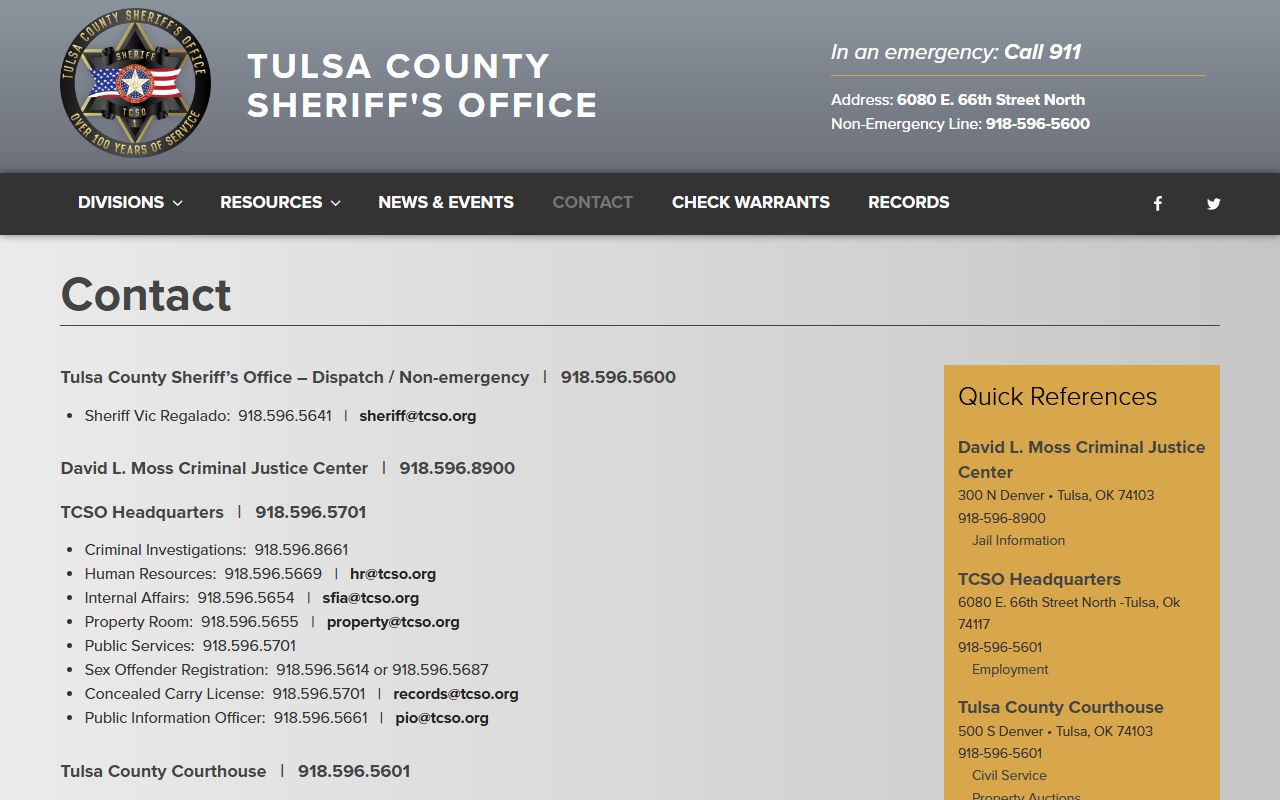
That page is the starting point for questions about a booking or for an open-records request tied to a Tulsa County arrest. Sheriff booking and incident records move through a mail or email request, not a casual web lookup.
City police arrests and incident reports run through Tulsa Police. The department offers an online system for non-court police reports.
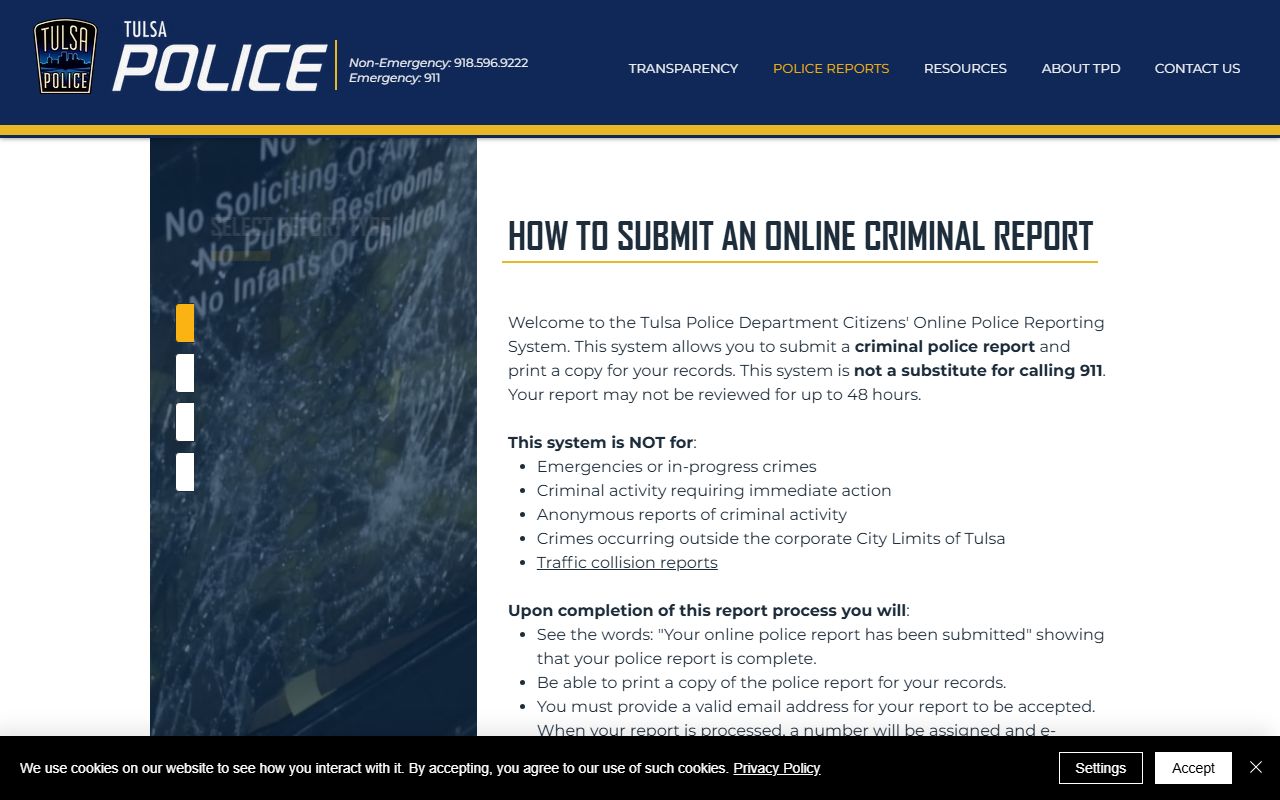
The Tulsa Police online police report page shows how city incident reports are filed, which can sit behind a city arrest before any court charge is filed.
Sheriff arrest and booking records move through a formal request. The Tulsa County Sheriff's Office takes open-records requests by U.S. mail or email only, and hand delivery is not allowed. Mail goes to the Public Information Officer at 6080 East 66th Street North, Tulsa, OK 74117, or email pio@tcso.org. A crime victim is entitled to one free copy of an incident report, and added copies follow the office fee schedule. Body-camera and 911 audio requests need detailed incident information on the required form.
Note: The offense listed at booking can differ from the charge the prosecutor files, so always confirm the court charge through the case docket rather than the arrest entry alone.
How Tulsa County Charges Get Filed
The charge record begins when a prosecutor files a charging document. In Tulsa County, the District Attorney for District 14, Steve Kunzweiler, reviews the arrest and decides the formal counts. The arrest can happen first; the charges follow once the office files. Three main charging documents start a criminal case in Oklahoma.
| Complaint | Information | Indictment | |
|---|---|---|---|
| Filed By | Officer or prosecutor | Prosecutor | Grand jury |
| Common For | Misdemeanors | Many felonies | Serious felonies |
| Starts | The case | The case | The case |
Most Tulsa County felonies move forward on an information after a judge finds probable cause at a preliminary hearing. The grand-jury route is less common. Whatever the document, the filed counts are what the docket tracks as the court charges after arrest.
Tulsa County Charge Codes and Levels
Each charge is tied to an Oklahoma statute and a case-type code. Felony filings carry a CF prefix. Misdemeanor filings carry a CM prefix. Criminal traffic and probable-cause matters use their own codes, such as TR or TRTU for traffic counts. The prefix tells you the severity level at a glance.
One arrest can produce several separate charges. A single incident may lead to a felony count, a related misdemeanor, and a traffic count, each listed on the same docket. Felonies carry the most serious penalties, misdemeanors carry lighter ones, and the statute cited next to each count points to the exact law alleged. The case-type code also signals which courthouse division handles the file, which matters when you request a certified copy of the charges.
Tulsa County Charge Status Explained
Charges are not fixed. They change as a case moves through the court. A count can be amended, reduced, added, dropped, or dismissed. The docket records each change with a date, so the current status may differ from the charge first filed.
| Status | What It Means |
|---|---|
| Pending | The charge is filed and active, and the case has not reached an outcome. |
| Amended / Reduced | The prosecutor changes a count, often lowering a felony to a misdemeanor. |
| Bound Over | After a felony preliminary hearing, the court finds enough evidence and sends the charge toward trial. |
| Dismissed | The court drops the charge; with prejudice it cannot return, without prejudice it may be refiled. |
| Nolle Prosequi | The prosecutor declines to pursue the charge and ends it. |
Bond After a Tulsa County Arrest
Soon after an arrest, the defendant has an initial appearance. A judge reviews the charges, sets or reviews bond, and addresses the right to counsel. Bond can be cash, a surety through a bondsman, or release on conditions. The court record logs the bond amount and type. If the person misses a court date, the court can issue a bench warrant, which shows on the case and may feed warrant systems.
The jail roster reflects current custody and the booking that followed an arrest, while the court file tracks the charge and bond history. The two views answer different questions about the same event. Court costs and fines tied to a charge can later be paid through OSCN e-payments using the case, citation, or payment-plan number.
Charges vs. Convictions
A charge is only an accusation. It is not proof of guilt. A conviction comes later, by a plea or a verdict, and only after the state meets a much higher standard. Tulsa County arrest records and charge records can show counts that never led to a conviction.
| Charge | Conviction | |
|---|---|---|
| Stage | Accusation by the state | Verdict or plea of guilt |
| Burden of Proof | Probable cause | Beyond a reasonable doubt |
| Public Record | Yes | Yes |
Statewide Charge and Criminal History Lookups
Charges filed in Tulsa County are part of Oklahoma's statewide court system. OSCN lets you search beyond one county by choosing All Oklahoma Courts in the court list. That pulls district-court charges from across the state under a single name search. It is the broadest free charge lookup tied to Oklahoma courts.
The results show filed counts, case types, and dispositions where they were entered. Sealed and expunged matters do not appear. OSCN covers court charges, not booking blotters, so the arrest detail still lives with the arresting agency and the jail. For a certified record or an older file, the Court Clerk's criminal and traffic counter can help.
Sealed vs. Expunged Charge Records
Some Tulsa County charge records can be removed from public view, especially after a dismissal. Oklahoma lets eligible people seal an arrest or charge record through a district-court expungement. The terms sealed and expunged are close but not the same.
| Sealed | Expunged | |
|---|---|---|
| Visibility | Hidden from public search | Treated as though it never existed |
| Law Enforcement | Limited access remains | Very limited access |
| Eligibility | Set by 22 O.S. § 18 categories | Granted by court order under 22 O.S. § 19 |
Expungement after a dismissal starts as a District Court petition under 22 O.S. sections 18 and 19. The person confirms eligibility, files where the case record exists, and serves the agencies that hold criminal-history data. If the judge grants the order, the public charge record is sealed from ordinary inspection.
Note: A dismissed charge does not vanish on its own, so the record can stay public until a court grants an expungement under the Oklahoma statute.
Background Check Considerations
A quick charge lookup is not a regulated background check. Employers, landlords, and licensing boards must follow federal and state rules when they use arrest or charge records for a decision. A formal report relies on certified data, not a casual docket scan. Charges that were dropped or dismissed need careful reading, since a charge alone is not a conviction.
Important: This site is not a consumer reporting agency under the Fair Credit Reporting Act, and its information cannot be used for credit, employment, tenant, or other FCRA-regulated decisions.
Restricted Charge Records in Tulsa County
Not every charge is open to public search. Juvenile charges are confidential under Oklahoma law and are not ordinary public dockets. Sealed and expunged charges drop off the public portal once an order is entered. Some dismissed charges are withheld after an expungement, and ongoing investigations may not show any filing yet.
Public copies can also redact private details. Social Security numbers, financial account numbers, minor names, protected addresses, and victim-safety information are commonly removed. When a charge record is restricted, the docket either omits it or shows only a limited entry, and full access may require a court order or a proper records request.